 Investment
What Hardship Withdrawals Reveal about Financial Wellness
Hardship withdrawals are an optional defined contribution plan provision that allows participants to access retirement savings for certain immediate financial needs. For many participants, a hardship withdrawal may feel like a last resort. Financial stress can carry emotional weight, and participants may be reluctant to discuss these decisions with their employer or seek help before accessing retirement assets. Recent survey findings highlight how many participants are using their retirement funds as a financial safety net with more than half of workers believing they may need to tap into their retirement savings for non-retirement expenses.1
While this feature is an important plan provision, usage can directly undermine employees’ long-term retirement readiness. Withdrawn assets are no longer invested, which reduces the opportunity to compound tax-deferred gains. Additionally, hardship withdrawals are subject to income tax and may also be subject to a 10% early withdrawal penalty for participants under age 59½.
When participants regularly access retirement savings to cover immediate expenses, it can signal growing financial strain, gaps in emergency savings, and result in premature withdrawal of retirement funds. For plan sponsors, this trend is more than an administrative data point, it is an opportunity to better understand participant needs and strengthen financial wellness strategies. It’s important for participants to feel supported and know that financial setbacks are usually temporary.
Hardship Withdrawal Basics
The first thing to know about hardship withdrawals is that they are an optional feature commonly included in plans. According to the 2025 PLANSPONSOR Defined Contribution Survey, nearly 90% of plans across all industries offer this feature.2 If a plan allows participants to take a hardship withdrawal, it must be due to an immediate and heavy financial need and limited to the amount necessary to satisfy that financial need. The IRS generally recognizes seven “safe harbor” reasons that satisfy these criteria:3
- Medical care expenses
- Costs directly related to the purchase of an employee’s principal residence
- Tuition, related educational fees and room and board expenses for the next 12 months of postsecondary education
- Payments necessary to prevent the eviction or foreclosure on a principal residence
- Funeral expenses
- Certain expenses to repair damage to principal residence
- FEMA-declared disaster-related expenses
Recent legislation has made hardship withdrawals easier for participants to access. The Bipartisan Budget Act of 2018 removed the requirement that participants first take an available plan loan before requesting a hardship withdrawal and eliminated the six-month suspension on employee contributions following a hardship withdrawal. This Act also expanded the contribution sources eligible for hardship withdrawals. Participants can now access elective deferrals, Qualified Nonelective Contributions (QNECs), Qualified Matching Contributions (QMACs), traditional and Qualified Automatic Contribution Arrangement (QACA) safe harbor contributions, and the earnings on those accounts – with the exception of earnings on 403(b) elective deferrals.
In 2022, SECURE 2.0 introduced another important change by allowing self-certification of hardship withdrawals in 401(k), 403(b) and 457(b) plans. This optional feature can reduce the administrative burden by allowing participants to certify their own hardship need without submitting supporting documentation. However, easier access may also contribute to repeated withdrawals. A recent Vanguard study found that more than 40% of participants who took a hardship withdrawal took more than one during the year, including 21% who took three or more.4
Important Tip – Reevaluate Self-Certification
Plan sponsors who have adopted self-certification may want to periodically review hardship transactions to ensure the feature is working as intended. It’s also important for plan sponsors to understand the self-certification process and how to obtain support from their recordkeeper.
Emergency Savings Gaps
Although market growth, automatic enrollment and higher contribution rates have improved overall retirement account balances, many participants lack the liquid savings needed to absorb near-term financial shocks. In many cases, hardship withdrawals appear to be serving as a last-resort emergency savings vehicle, even though retirement plans were not designed for that purpose.
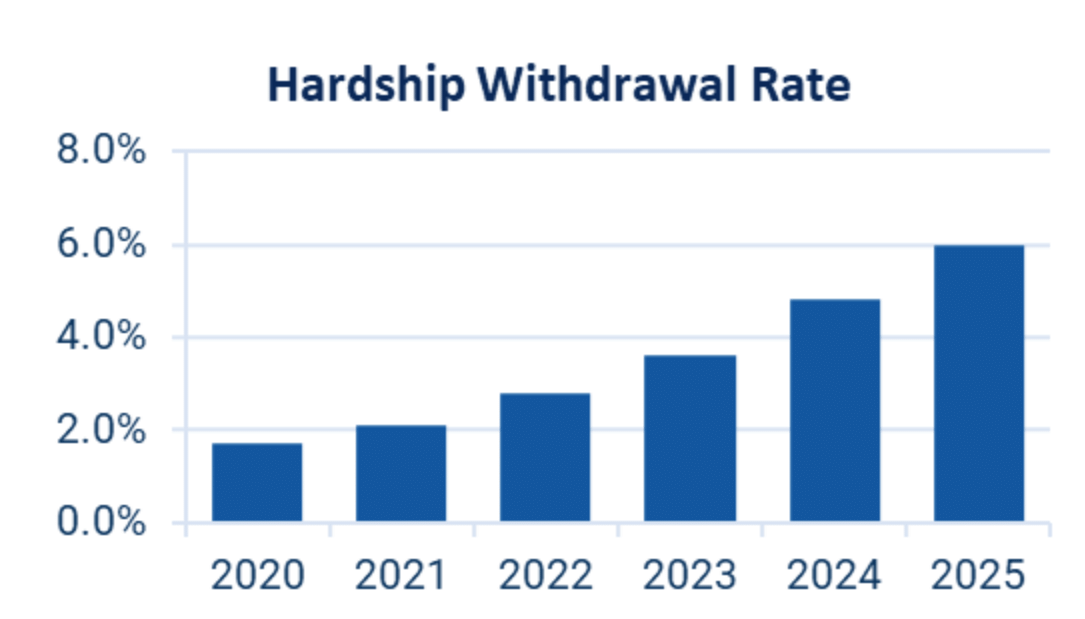 One unexpected bill can quickly create financial strain. Nearly 2 in 5 Americans say they could not afford an emergency expense over $400.5 Without sufficient emergency savings, many workers turn to their workplace retirement plan. This lack of savings may explain why hardship withdrawal rates have increased almost 1% per year over the past 5 years to 6%.6
While a hardship withdrawal can help address an urgent need, it will also reduce a participant’s account balance and may trigger taxes or penalties. Plan sponsors should consider ways to encourage participants to save for both retirement and short-term needs, with a common guideline of maintaining 3 to 6 months of essential living expenses in emergency savings. Moreover, plan sponsors may consider incorporating savings plans into their retirement plans.
The goal shouldn’t be to simply increase emergency savings but to help participants build financial resilience while protecting retirement assets. Plan sponsors may want to consider emergency savings solutions that integrate with payroll and make it easier for employees to build short-term savings alongside retirement contributions. Two common approaches include:
- Pension-Linked Emergency Savings Accounts (PLESAs) – This optional provision under SECURE 2.0 allows an employee to make Roth contributions up to a maximum of $2,600 for 2026 in a short-term savings account linked to a defined contribution plan. Despite their potential, adoption remains low, largely because of administrative complexity. PLESAs require integration with payroll systems, participant notices and careful fiduciary oversight.
- Out of Plan Emergency Savings Accounts (ESAs) – An ESA is a portable employer-sponsored plan that helps an employee build an emergency savings fund. Unlike the PLESA, these accounts are not linked to the retirement plan. Employees may contribute fixed dollar amounts and can generally access funds at any time without penalties. These accounts can be administered internally or through a third-party provider. Since these accounts sit outside the retirement plan, they may be easier to administer than PLESAs while still helping employees build an emergency savings cushion.
Alternative Withdrawal Options
Before participants access retirement savings, plan sponsors should try to help them understand the consequences of hardship withdrawals and consider whether other plan features, such as loans or expanded in-service withdrawal options, may better support short-term financial needs.
A plan loan allows participants to borrow from their retirement account and repay the amount, with interest, typically through payroll deduction. Unlike hardship withdrawals, loans are not taxable or subject to early withdrawal penalties if repaid on time. However, missed payments may result in taxation and penalties, so participants should understand repayment obligations before borrowing.
SECURE 2.0 expanded in-service withdrawal options for domestic abuse victims, terminal illness and emergency personal expenses of up to $1,000 per calendar year for 401(k), 403(b) and 457(b) plans. These options may be exempt from the 10% early withdrawal penalty and may allow repayment, making them important alternatives for plan sponsors to understand and communicate.
Final Thoughts
Plan sponsors can use hardship withdrawal activity to identify financial wellness gaps and evaluate whether participants need additional education, emergency savings support or plan design flexibility. Ensure that your plan offers alternatives such as plan loans and in-service withdrawals and if it doesn’t, consider adding these features so that participants can use one of these as a first line defense.
Targeted communications can help participants better understand their options and the long-term impact of hardship withdrawals. Rather than relying only on broad financial wellness campaigns, plan sponsors can use plan data to identify trends, such as repeat hardship withdrawals or increased activity among certain participant groups. Working with their recordkeeper and investment advisor, plan sponsors can develop timely, relevant messages that encourage participants to build emergency savings, understand the consequences of withdrawals, and explore available resources before accessing retirement assets.
Hardship withdrawals can be both a financial lifeline and a source of significant stress. Research shows that participants who take hardship withdrawals are nearly three times more likely to report constant stress and three times more likely to feel stressed about their finances.7 By helping participants understand their options, rebuild emergency savings and regain stability after a setback, plan sponsors can support more informed decision-making while helping protect long-term retirement readiness.
For additional insight or to discuss how these considerations may apply to your plan’s unique objectives, please contact our team at investment@boltonusa.com.
[1] https://www.pwc.com/us/en/services/consulting/human-resources/library/employee-financial-wellness-survey.html
[2] PLANSPONSOR 2025 Defined Contribution (DC) Survey
[3] For government 457(b) deferred compensation plans, hardship distributions are limited to unforeseeable emergencies, such as a severe financial hardship resulting from illness, accident, casualty loss or similar extraordinary circumstances beyond the participant’s control.
[4] https://workplace.vanguard.com/content/iig-transformation/pdf/how-america-uses-hardship-withdrawals.html
[5] https://www.empower.com/the-currency/money/over-1-in-5-americans-have-no-emergency-savings-research
[6] https://workplace.vanguard.com/content/iig-transformation/pdf/how-america-uses-hardship-withdrawals.html
[7] Fidelity/PLANADVISER, Helping Participants After They Have Taken Hardship Withdrawals
Related Articles
Investment
Investment
Investment