At a glance:
- Salary budgets: ~3.0% median for government, nonprofit and education; 3.5%–3.6% for U.S. employers overall
- Inflation: 7% CPI (September 2026); 2027 COLA of 3.6%
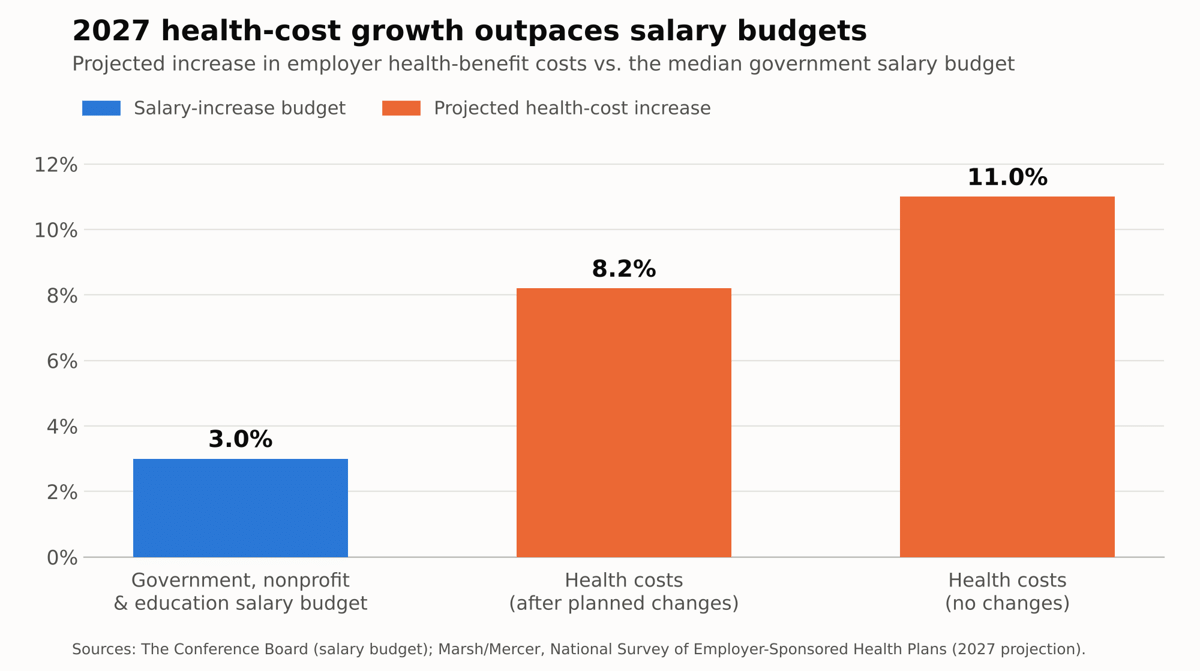
- Health costs: +8.2% after plan changes; +11% without
Public employers are heading into 2027 with less room than they need. Government, nonprofit and education organizations project a median salary-increase budget of about 3.0%, while broader U.S. employer surveys cluster at 3.5% to 3.6%. Both trail September’s 3.7% inflation rate and sit near the 3.6% Social Security COLA—the two benchmarks employees notice most. Meanwhile, health-benefit costs are projected to climb 8.2% even after planned cost-saving changes, or 11% without them.
Here are the numbers, what they mean for your budget, and six decisions to settle before submission.
The Conference Board projects a 3.0% median for government, nonprofit and education employers, compared with 3.5% for all U.S. employers. Other national surveys align on the broader market: Payscale reports a 3.5% average and median; WorldatWork, a 3.6% mean and 3.5% median.
These are budget benchmarks, not individual raises. Test them against peer agencies, bargaining agreements, hard-to-fill roles and internal equity needs.
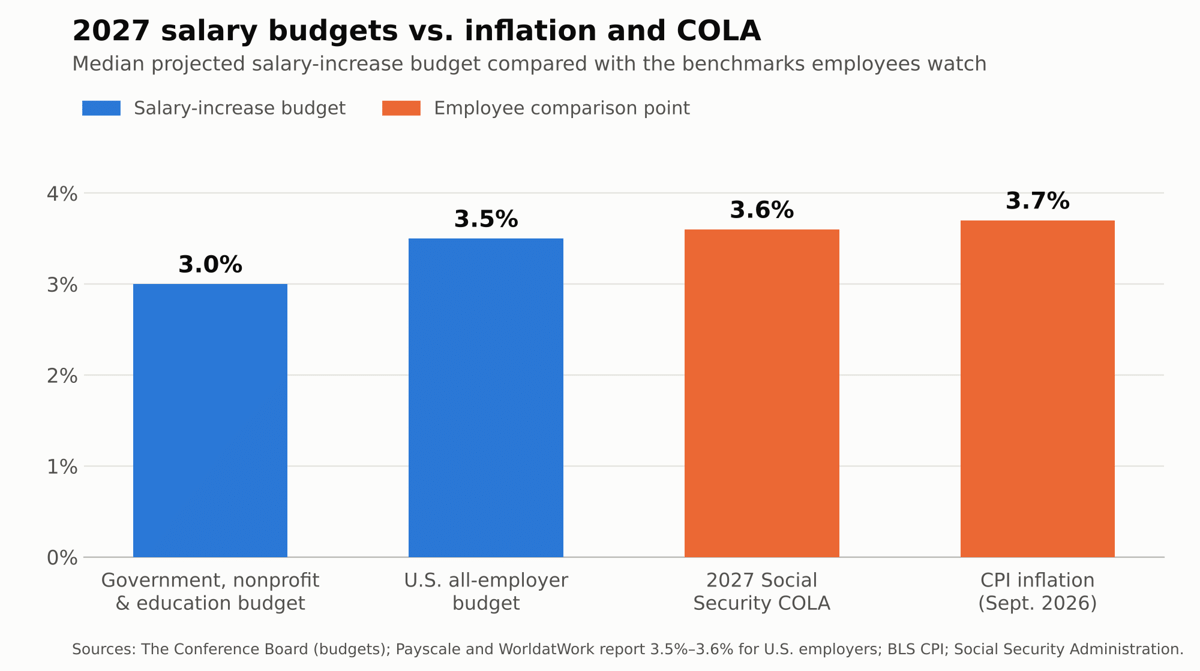
Consumer prices rose 3.7% in the 12 months through September 2026, up from 3.4% in August (Bureau of Labor Statistics). The Social Security Administration set the 2027 COLA at 3.6%.
Against September CPI, a 3.5% budget falls 0.2 percentage points short; a 3.0% budget, 0.7 points. Employees will draw that comparison on their own—address it in your messaging first.
Marsh/Mercer research projects employer health-benefit costs will rise 8.2% in 2027 after planned changes, or about 11% if plans stay as they are—the steepest increase since 2003.
Health insurance makes up 11.4% of total compensation for state and local governments (BLS Employer Costs for Employee Compensation, June 2026). As a simplified illustration, an 8.2%–11% increase on that share adds about 0.9 to 1.3 percentage points to total compensation cost before any salary increase. Substitute your own renewal and cost-sharing figures.
When salary structures move more slowly than actual pay, incumbents creep deeper into their ranges. New hires start near long-tenured staff, and supervisors can end up earning little more than those they lead. Funding structural fixes separately keeps them from eroding individual increases.
Assumes a July 1 fiscal year; for October 1, shift each step three months later.
Many agencies update assumptions each fall, when September CPI and the next year’s COLA are typically announced.
Korn Ferry found only one in three organizations (33%) believe their managers can explain pay decisions effectively. A four-part script helps:
What budget are government employers planning for 2027?
About 3.0% at the median for government, nonprofit and education employers. Your figure should reflect peers, contracts and critical roles.
Should raises match the Social Security COLA?
The COLA isn’t a pay benchmark, but employees will compare against it. If your increase lands lower, explain how it was set and what else the organization is absorbing.
Should compression fixes come out of merit?
We recommend funding them separately. Shared pools shrink individual increases and leave the underlying problem in place.
When should planning start?
For a July 1 fiscal year, begin in January and submit scenarios in March or April. For October 1, begin in April and submit in June or July.
Bolton’s Rewards practice supports public employers with peer-agency market studies, compression and pay equity diagnostics, pay plan design and employee communication. Book a 45-minute scenario review—bring your current pay plan, preliminary health renewal and peer list.
 Health
 Investment
Health
This site uses cookies to improve your experience. By continuing to browse, you agree to our use of cookies.